Sanctuary in the Blue Hour
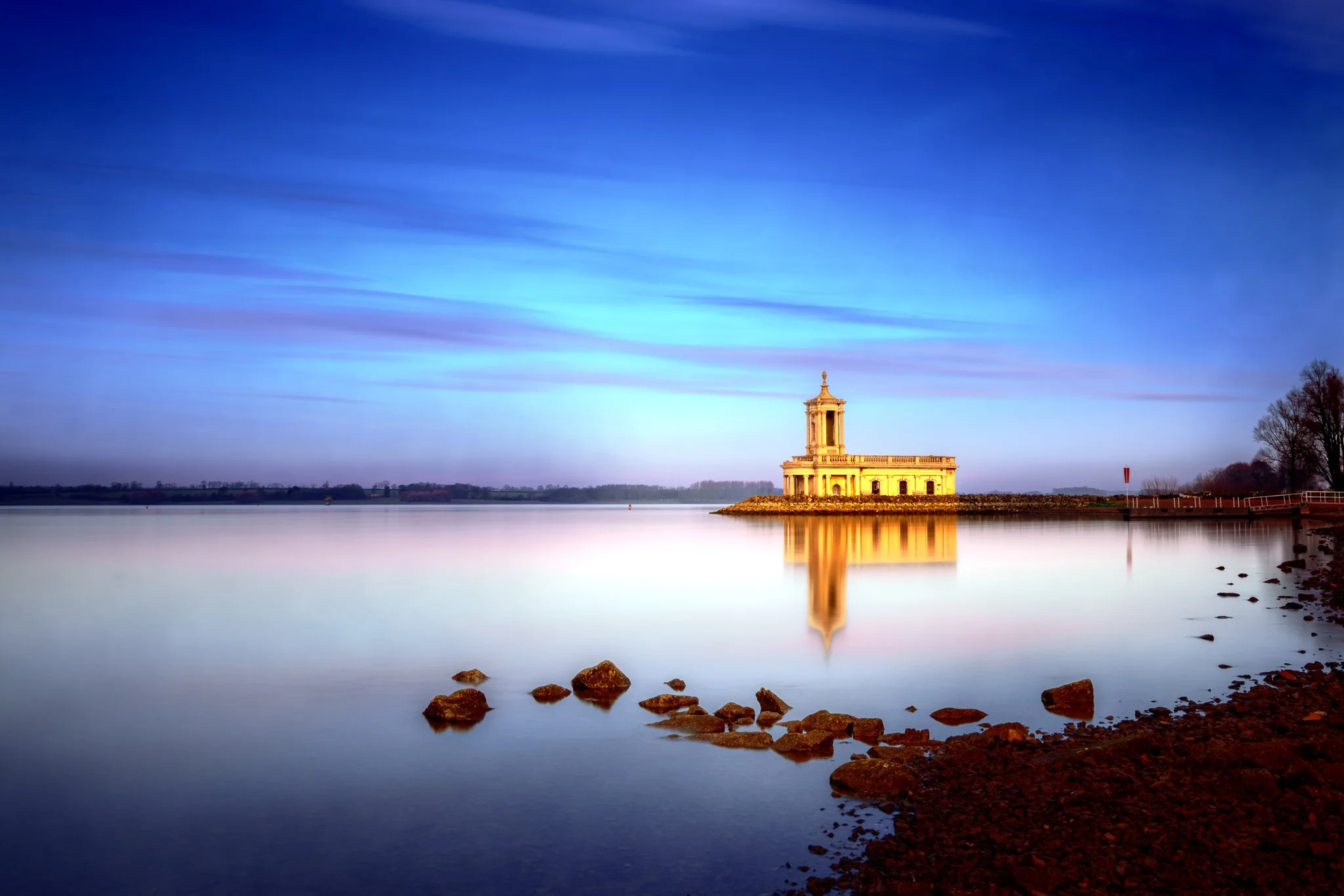
Rutland Water, United Kingdom
As evening settles over Rutland Water, the familiar outline of Normanton Church emerges with quiet clarity against the fading light. The transition into blue hour softens the landscape, allowing colour and tone to take precedence over detail. In this moment, the scene becomes less about place and more about atmosphere.
The church stands slightly removed from the shoreline, surrounded by still water that reflects its form with near-perfect symmetry. Its illuminated façade introduces warmth into the composition, contrasting gently with the cool tones of the surrounding sky and lake. This balance between warm and cool light creates a subtle tension that draws the viewer’s attention without overwhelming the overall calm.
The long exposure transforms the water into a smooth, uninterrupted surface, dissolving movement and reinforcing the sense of stillness. The reflection becomes an extension of the structure itself, elongating its presence and anchoring it within the composition. Together, the building and its reflection form a vertical axis that stabilises the image.
Above, the sky carries soft bands of colour that drift across the frame. These subtle variations in tone introduce movement without disruption, providing a gentle counterpoint to the solidity of the church. The gradation from deeper blue to lighter hues near the horizon adds depth while maintaining a restrained and cohesive palette.
In the foreground, scattered stones rest along the edge of the water. Their darker tones and irregular shapes introduce a grounded texture that contrasts with the smoothness of the lake. They act as a quiet entry point into the scene, guiding the viewer’s eye toward the central subject without competing for attention.
The surrounding landscape remains understated. Distant trees and shoreline elements are present but subdued, allowing the church to hold its place within the wider environment without isolation. This balance ensures that the image feels complete, with each element contributing to the overall sense of calm.
The composition is carefully weighted. The church is positioned off-centre, allowing space for the sky and water to breathe. This use of negative space enhances the contemplative quality of the photograph, encouraging a slower and more deliberate engagement.
This photograph captures a moment of quiet equilibrium — where light, structure, and reflection align. It is not defined by a single element, but by the relationship between them, offering a scene that is both grounded and expansive, familiar yet quietly transformed.